Making Meaning of Crime in the 2026 Midterm Primaries
August 13, 2026
|
Brian Tashman, Insha Rahman, and Sam Raim

In a July 2026 Reuters/Ipsos poll, only 3 percent of registered voters said crime is the most important problem facing the United States today. Yet both Democrats and Republicans have raised crime’s salience during this primary cycle by using it as a wedge. 

While crime may not be a top issue for voters, it is nonetheless an important one. Gallup polling in March found that concern about crime in 2026 declined for the third year in a row amid historically low crime rates. But still more than two-thirds of respondents (68 percent) said they were worried a great deal or a fair amount about crime. Even if crime is not top of mind like affordability or healthcare, it still greatly matters to voters.

Democrats, mired in infighting between the left and moderate wings of the party, are rehashing the “defund” debate with old tweets and statements by progressive candidates back in the spotlight. This debate is more about rhetoric and electability than policy:  Bernie Sanders, Alexandra Ocasio Cortez, and Zohran Mamdani have all recently made clear that “defund the police” is no longer a position pushed by any flank of the party. But by remaining stuck in the outdated “defund” debate, Democrats are opening themselves to November attacks and missing an opportunity to instead highlight the new path forward on public safety that has effectively become the party’s consensus in governing (despite differences in campaign rhetoric). Republicans, unified under a “law-and-order” banner, have already begun holding press conferences in Texas touting “tough-on-crime” bona fides and running ads that paint Democrats as soft on crime in states like North Carolina, Ohio, Pennsylvania and Michigan

In a debate between being “tough” and “soft” on crime, both parties (and many political pundits) are misunderstanding where the majority of voters are. When asked to choose between a traditional “tough-on-crime” approach and being “serious about safety,” Vera Action’s polling this cycle found that voters consistently choose a “serious” one. This trend held in national and state-specific polls, including the key battleground states of Michigan, North Carolina, and Wisconsin, as well as among independent and moderate voters.

Even if it isn’t exactly right, which of the following is closer to your view?

We should fully fund things that are proven to create safe communities—like good schools, jobs, and affordable housing—and help prevent crime by increasing treatment for mental health and drug addiction and by getting illegal guns off the street.

We should do more to get tough on crime—like having tougher sentences for people convicted of violent crimes, maintaining strong bail laws to keep dangerous people in jail, and providing police with more support and resources.

Sources: YouGov June 2026 national survey commissioned by Vera Action, GSG January 2026 survey of likely Wisconsin voters commissioned by Vera Action, YouGov April 2026 survey of registered North Carolina voters commissioned by Vera Action, July 2026 Lake Research Partners survey of likely Michigan voters commissioned by Vera Action

Candidates up and down the ballotincluding for United States Senate, Congress, and governor’s officesran and won on strong “serious about safety” platforms that emphasized preventing crime before it happens, supporting effective and accountable policing, and investing in proven solutions that are already contributing to historic crime declines.

These polling results corroborate Vera Action’s previous rounds of public opinion research on voters and crime, including in the 2022 and 2024 cycles. With polling results wildly off in the 2026 Michigan, Minnesota, and Wisconsin primaries, Vera Action’s polling can be trusted because our Michigan poll, conducted by respected pollster Lake Research Partners in July 2026, had Abdul El-Sayed up by only two points against his opponent, Representative Haley Stevens, in the Democratic primary for U.S. Senate—a much closer prediction to the actual primary result. This same poll found that 61 percent of Michigan voters preferred a “serious-about-safety” approach over a “tough-on-crime” approach.

As the Republican Party loses its advantage on the economy and immigration, the crime scare tactics will only get louder in the general election. This is especially true in the small number of contested races that will decide which party controls Congress. If Democrats leave the “soft-on-crime” attacks unchecked, Republicans could overcome Democrats’ 6.7 point lead in the generic ballot average. Yet Democrats have a winning campaign strategy—should they choose to take it. Instead of staying on Republicans’ narrative turf and debating being “tough” or “soft” on crime, which has been a losing strategy in recent cycles, Democrats should heed the data, follow the voters, and adopt a “serious about safety” approach.

Vera Action compiled five takeaways to make meaning of how crime factored into this cycle’s primaries.
TAKEAWAY #1:

Winning candidates from across the political spectrum fought for a break from the status quo—especially on the safety threat posed by Trump’s abusive immigration agenda.

Voters’ anger at the establishment—both the Trump administration’s overreach and Democrats’ perceived lethargy in the face of federal threats—has dominated headlines during the 2026 primary season. Nowhere is that anger more palpable than in response to U.S. Immigration and Customs Enforcement (ICE) raids and the Trump administration’s abusive federal law enforcement practices. Recent polls show that 85 percent of Democratic voters and two-thirds of independents have an unfavorable opinion of ICE.  

In some primaries, threats to voters’ safety from the Trump administration emerged as a top issue. The Laken Riley Act, a bipartisan “migrant crime” bill named after the victim of a tragic murder by an immigrant in Georgia, became a consistent flashpoint this cycle. Passed by Republicans in early 2025 with bipartisan support, the legislation expanded mandatory detention for immigrants and helped set up Trump’s mass deportation agenda.

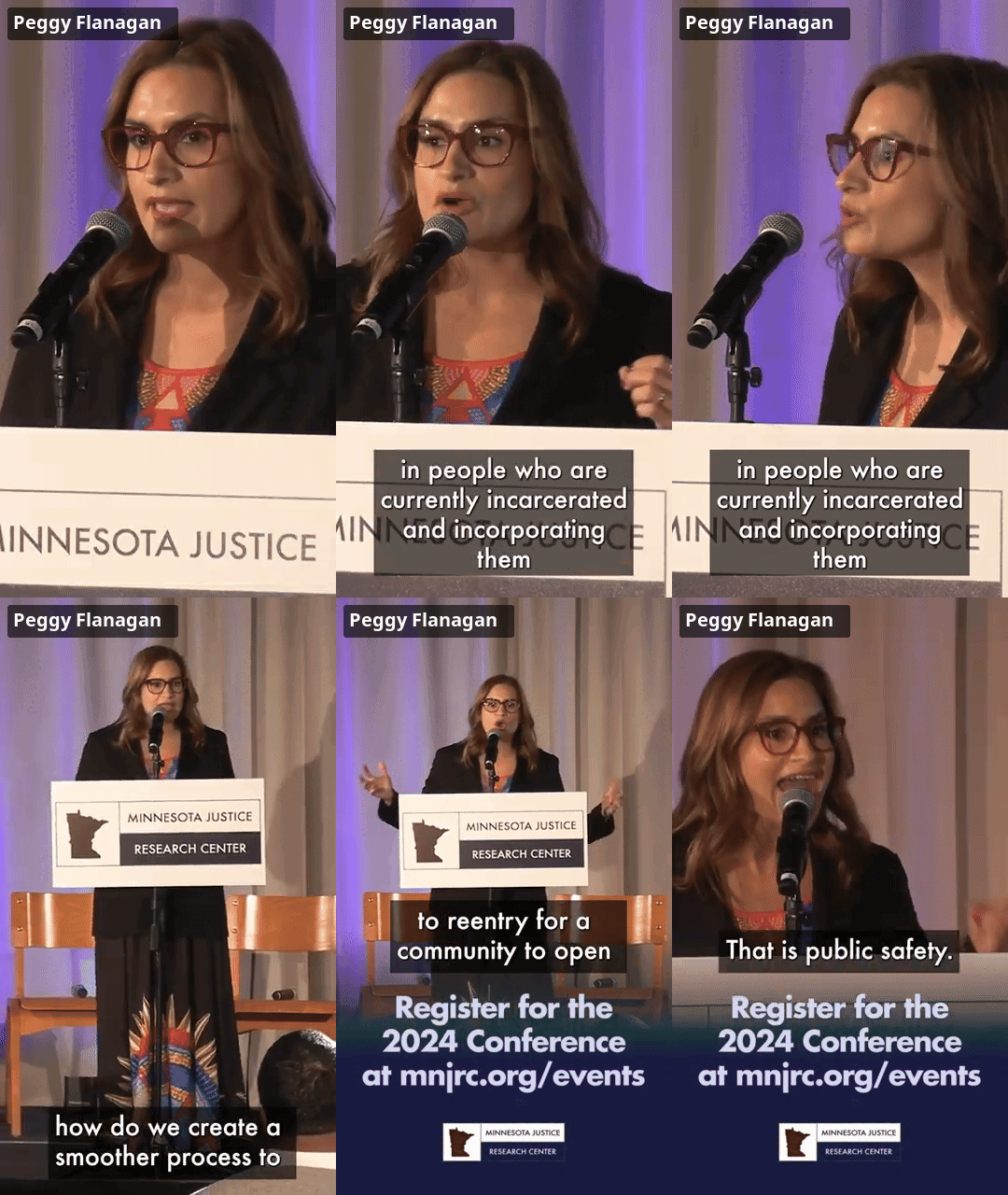
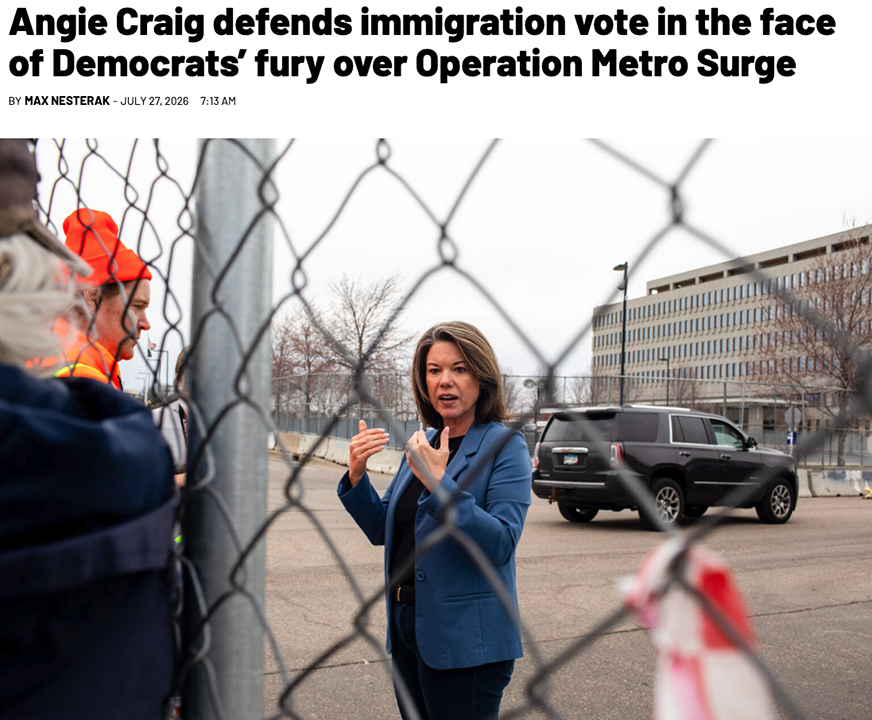
Multiple Democratic officials have since apologized for their votes for the bill, and it became central to the primary for U.S. Senate in Minnesota, where Representative Angie Craig voted for the bill. Minnesota Lieutenant Governor Peggy Flanagan captured the Democratic nomination for U.S. Senate after aggressively speaking out against the Laken Riley Act and ICE operations while putting forward her own affirmative vision, noting it’s “time for Congress to get serious about safety.” While President Trump was tearing apart communities and families with mass raids in Minnesota, Flanagan presented a safety agenda to “address the root causes of crime—including mental health, addiction, and economic security,” adding that “real safety for our communities comes from both accountability and rehabilitation for people who commit crimes.”

Meanwhile, her opponent, Representative Craig, was dogged by criticism over her vote for the Laken Riley Act, which she eventually recanted. She also played defense over her vote in June 2025 backing a resolution that included a provision expressing “gratitude to law enforcement officers, including U.S. Immigration and Customs Enforcement personnel, for protecting the homeland,” which two-thirds of House Democrats opposed. During the Illinois Senate Democratic primary, Representative Raja Krishnamoorthi lost his once-formidable lead after getting hammered on the airwaves and in debates for his support of that resolution. And in Maryland, while attacks on Representative April McClain Delaney’s vote for the Laken Riley Act were not enough to propel former Representative David Trone back into his old seat, the primary did lead Delaney to recant her vote, showing how any support for ICE has become impermissible among Democrats.

In Pennsylvania, union leader Bob Brooks won a competitive primary for Congress while citing his record as a first responder to challenge President Trump’s claims that ICE makes us safer. Brooks said, “I spent 20 years as a Bethlehem firefighter—if anyone wants to have a conversation about keeping our community safe, I’ll lead that charge. But it’s plain as day that what’s happening right now with Trump’s ICE is not public safety.”

In Colorado’s 8th district, state Representative Manny Rutinel handily defeated establishment-backed state Representative Shannon Bird in the primary after drawing attention to Bird’s vote against a proposal to curtail state and local collaboration with federal immigration enforcement. Rutinel said in one ad, “Shannon Bird was the only Democrat to vote with Republicans to let police cooperate with ICE and let ICE raid our schools and hospitals.”

A closely watched House primary in California’s 22nd district saw college professor Randy Villegas advance to the general election over fellow Democrat Jasmeet Baines. Villegas criticized Baines for failing to support a bill prohibiting ICE agents from wearing masks while she was in the state senate.

TAKEAWAY 2:

In highly contested primaries, a majority of Democratic candidates adopted a “serious about safety” approach—and those who opted to go “tough” lost.

Even as Democrats continue to attack one another over past “defund” rhetoric, public safety is increasingly becoming a big tent issue for the party as a matter of policy and governing. Across the country, state and local Democrats have presided over historic crime declines that many experts attribute to a comprehensive approach to public safety, and most candidates are campaigning on these proven solutions.

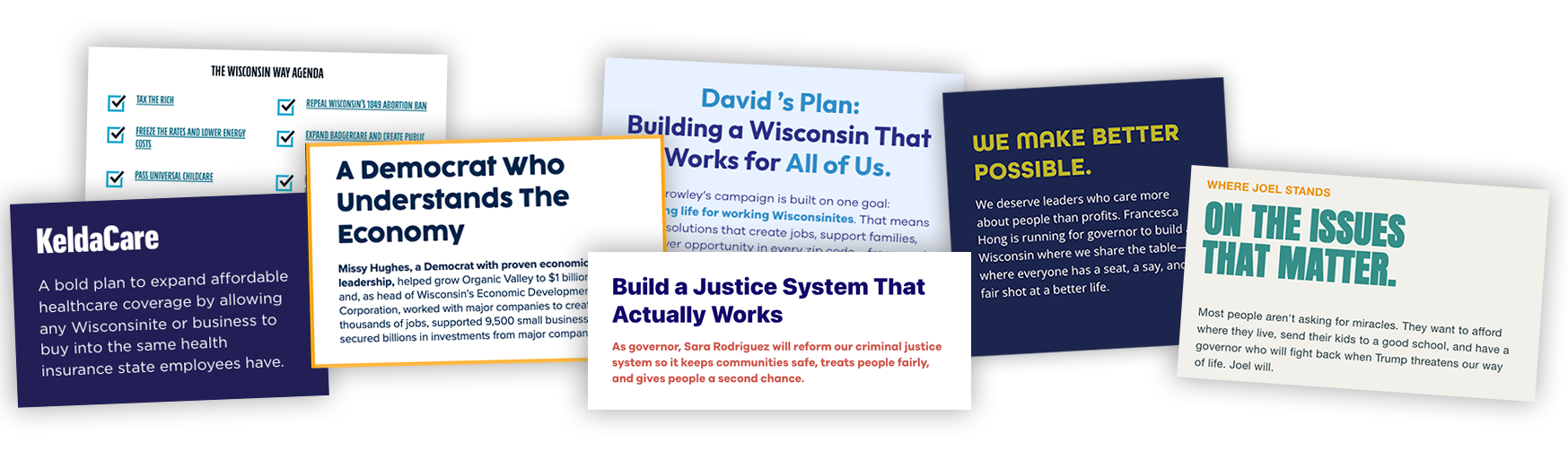
In Wisconsin’s chaotic gubernatorial primary, all the major Democratic candidates  had striking similarities in their public safety platforms, including eventual winner Milwaukee County Executive David Crowley and runner-up State Assemblymember Francesca Hong. While groups supporting Crowley’s campaign attacked Hong’s past support of “defund,” his rhetoric and record on safety and justice align with Hong’s declaration that she is “serious about public safety” and would invest “in the things that we know prevent crimes.” Crowley urged new funding for mobile crisis response teams to lift the burden from police. He also touted the fact that he  “co-authored legislation to close Lincoln Hills and Copper Lake, Wisconsin’s scandal-plagued youth prisons” and funded investments in drug treatment, housing, justice systems, and reentry programs. 

The same was true across the whole field. Businessman Joel Brennan attacked unaccountable federal deployments for making “everyone less safe” and talked about supporting violence prevention; State Senator Kelda Roys outlined policies to “get smart about preventing crime, instead of continuing to pursue wasteful, failed policies that make us less safe, less just, and less free;” Lieutenant Governor Sara Rodriguez called for safety, accountability, and justice while lamenting that “politicians have played tough-on-crime politics while ignoring what actually works,” and former Lieutenant Governor Mandela Barnes pledged sweeping investments in mental health care and other “preventative programs that stop crime before it starts.”

A similar situation played out in Missouri, where Representative Wesley Bell again defeated former Representative Cori Bush in their highly watched rematch. Bush ran on community investment, crime prevention, and crisis response, while Bell ran on “defunding and dismantling ICE” and his record as a prosecutor of supporting diversion programs and restorative justice (as well as calling for “more” and “better” policing). 

In Colorado, Attorney General Phil Weiser upset Senator Michael Bennet, who once had a double-digit lead in the polls, in the race for governor. Weiser pledged to establish a statewide Office of Safe Communities focused on preventing crime, “ensure that access to bail and justice is based on public safety risks, not how much money you have,” and increase investments “in co-responders—so addiction and mental health crises are met with compassion and treatment, and law enforcement officers are freed up for incidents that threaten public safety.” Bennet similarly touted a “comprehensive approach that includes support for law enforcement, investments in mental and behavioral health, and community crime prevention and intervention,” but it was not enough to overcome Weiser’s record of resisting Trump.

Elsewhere, “serious” candidates effectively drew a stark contrast, as in the Democratic gubernatorial primary in New Mexico, a state where crime is a top issue for many voters. Sam Bregman, a prosecutor known for his “tough-on-crime approach” lost to Deb Haaland, a former congresswoman and cabinet secretary. Haaland shored up her public safety credentials by releasing a strong platform that emphasized her commitment to addressing the root causes of crime and to “create an Office of Community Safety that will be staffed with social workers, counselors, and behavioral health professionals, because true safety cannot be built on enforcement alone.”

In the closely watched race for mayor of Washington, DC, Councilmember Janeese Lewis George won the Democratic primary in a landslide. Public safety emerged as a top issue, as many voters expressed concern about the increased presence of federal law enforcement officials including ICE and the National Guard. At the same time, there was intense scrutiny of “teen takeovers” and viral brawls involving teenagers.

Lewis George released a strong platform on community safety and emphasized her work on the city council and as a former prosecutor in support of justice reform. Her main rival, former Councilmember Kenyan McDuffie, had a strong record as a voice for justice reform while on city council and came out early with a safety and justice platform. But he spent the closing months of the race running opportunistic “soft-on-crime” attacks against Lewis George and campaigning as the “tough-on-crime” candidate.

Not far from Washington, Baltimore County State’s Attorney Scott Shellenberger lost re-election despite touting his endorsement from the Fraternal Order of Police, which heralded his “proven record of being tough-on-crime.” His successful challenger, Sarah David, campaigned on taking a different approach, including investing in diversion programs, partnering with social workers to prevent crime before it happens, and expanding community partnerships. In Montgomery County, Maryland’s most populous county, County Councilmember Will Jawando won the Democratic nomination for county executive on a platform focused on improving trust in law enforcement, preventing crime and homelessness, and investing in housing, mental health care, and youth programming.

In Los Angeles, Mayor Karen Bass and Councilmember Nithya Raman both advanced to the general election, with “tough-on-crime” former reality TV star Spencer Pratt coming in third despite massive media attention for his harsh rhetoric and lurid AI-generated campaign videos about crime and social disorder. Raman put forward a “serious-about-safety” platform that elevates community violence intervention, civilian-led crisis response, and community trust. Bass ran on her record of establishing the city’s Office of Community Safety and overseeing a historic crime decline.

Finally, in Harris County, Texas, one of the largest counties in the country, the establishment-backed former mayor of Houston lost the Democratic nomination for county judge, the county’s top executive position, to a reform-minded former city councilmember. Winner Letitia Plummer championed criminal justice reform and “community-centered public safety,” including reducing recidivism and supporting civilian crisis response to certain 911 calls. She especially took issue with her opponent’s support for Kim Ogg, the county’s former “tough-on-crime” prosecutor, who was thrown out of office by voters in 2024.

TAKEAWAY 3:

A strong consensus is emerging among Democratic gubernatorial candidates around a “serious” approach.

Democrats’ increasingly unified governing approach to public safety was especially prominent at the state level, with 39 gubernatorial races this election cycle. A strong consensus for a “serious-about-safety” approach is emerging among these candidates. In addition to Crowley in Wisconsin, Haaland in New Mexico, and Weiser in Colorado, gubernatorial nominees in Ohio, Georgia, and elsewhere are running on “serious” platforms.

In Ohio, Amy Acton ran unopposed in the Democratic primary.  Her public safety platform declares, “Keeping Ohioans safe is my top priority as governor. Everyone deserves to feel and be safe in their communities, no matter where they live.” Acton has stressed the need to “ensure that communities again have the public safety resources they need” while also acknowledging that “crime is often a symptom of other community and societal problems, and we must work to address the underlying root causes by investing in education and career opportunities in both small towns and large urban centers, tackling poverty, and providing treatment and support services for those experiencing mental health and substance use disorder issues.” 

Former Atlanta mayor Keisha Lance Bottoms, who won the Democratic nomination for governor of Georgia, proposed new support for law enforcement agencies like the Georgia Bureau of Investigations, coupled with expanding “diversion and treatment options for nonviolent cases” and “reentry pathways through the Prison to Work initiative so more Georgians leaving prison have a real chance to succeed instead of cycling back into the system.”

Running for re-election, Maryland Governor Wes Moore touted his administration’s work to advance “criminal justice reforms, including expanding eligibility for record expungement to help more Marylanders access jobs,” coupled with strong progress on public safety. “You cannot address violent crime if you aren’t addressing the failed conditions in communities where violence is prevalent,” his campaign said. It is notable that Moore, under whose leadership Maryland has become a standard bearer for justice reform, has a 56 percent approval rating and continues to be discussed as a possible presidential candidate for 2028.

TAKEAWAY 4:

The narrative that progressive candidates in competitive races distanced themselves from “defund” is incomplete. They pivoted to solutions for crime prevention and effective, accountable policing.

While no election results can be winnowed down to one winning or losing factor, “defund” attacks may not have had the potency that conventional political wisdom would assume. In both the Michigan Senate and Wisconsin gubernatorial races, progressive candidates’ previous statements about “defunding the police” dominated the airwaves in the final weeks. Both Abdul El-Sayed and Francesca Hong took similar approaches. Neither stayed silent or simply rejected previous statements. Instead, like New York City Mayor Zohran Mamdani did as a candidate last year, they clearly stated that they did not want to defund the police and took the opportunity to talk about what effective, accountable policing looks like, and how it fits within a comprehensive vision for delivering public safety. 

Hong said, “I want to focus on stopping violent crime and giving law enforcement the resources and training they need. But ensure that we are also holding accountable law enforcement that does not follow the law.” For his part, El-Sayed responded, “I’ve been clear about what I believe, which is investment in the things that keep people healthy and safe, which includes recruitment, retention, and retirement for law enforcement and includes investment in behavioral health response and community violence intervention.” 

Instead of running away from the emotional tenor that emerged (albeit briefly) across the country in the wake of George Floyd’s murder by a police officer, both Hong and El-Sayed reminded voters of why Americans deserve better—especially against the backdrop of abusive and unchecked immigration enforcement under the Trump administration.

This response works: in Vera Action’s Michigan poll, we tested a “defund” attack against a message from El-Sayed about “a new approach to law enforcement” that supports officers doing difficult jobs, demands accountability when law enforcement  breaks the law, and invests in proven solutions that prevent crime and break its cycle. This response beat a “defund” attack by 13 points. With this message—along with powerful messages about tackling the country’s affordability crisis and sending a Democratic brawler to face off against Republicans in November—El-Sayed overcame the attacks to win

Vera Action’s national polling also shows that voters favor this kind of response over a “tough” message that attacks “defund”:

Though Francesca Hong ultimately lost—possibly in part due to her opponent outspending her roughly eight-to-one on ads—it is unclear how significantly the “defund” attacks factored into Crowley’s narrow victory or whether she was actually ever a frontrunner in the race.

In Colorado’s 1st congressional district, Melat Kiros won despite facing a multimillion-dollar barrage of attack ads. Kiros inoculated herself against “defund” attacks not only by calling out the threat to safety from federal agencies like ICE, but also by talking about her own affirmative vision that “we cannot arrest our way out of poverty or criminalize mental illness.” She argued, “The data has shown over, and over, and over again, that safety grows in well-resourced communities, not over-policed ones. When we protect people’s basic needs and uphold their dignity, everyone is safer.”

Though we are six years past 2020, the success in raising a media frenzy around “defund” in these races and the inevitable Republican attacks will all but ensure that this remains an issue in future elections. But it is no longer the silver bullet it once was, and many candidates are finally learning to navigate this issue by giving voters the “serious” approach to safety they want.

TAKEAWAY 5:

If Democrats don’t own the historic declines in crime, Trump will.

Crime is continuing the massive decline that began before Trump retook office. Democratic-led cities like Albuquerque, Baltimore, Boston, and Oakland, often disparaged by the right as high-crime “hellholes,” have massively reduced crime. Predictions of a crime surge in New York City if Zohran Mamdani won the mayoral contest have fizzled as crime has plummeted to a historic low.

Nevertheless, even as President Trump’s advantage on crime has evaporated, a recent Vera Action poll showed that Republicans have a 10-point advantage when it comes to which party is more responsible for declining crime. But the problem may be that many voters are simply not hearing from Democrats on crime. In a subsequent test, we gave voters a message about how “crime started declining before Trump took office and after many Democratic-led cities started implementing safety strategies focused on preventing crime before it happens.” With this message, the Republican advantage disappeared: an equal number of voters gave each party credit.

Local leaders are leading the way in delivering this message. “We are making progress on public safety that many thought was impossible,” said Baltimore Mayor Brandon Scott about his city’s historic crime drop, which has been found directly related to Johnson’s signature violence prevention initiative. He has explained, “This is about public health . . . this is about jobs and opportunities, this is about getting rid of vacant houses.” Newark Mayor Ras Baraka similarly noted that his city is currently seeing a “homicide rate that hasn’t been this low since Eisenhower was president” and that crime and violence are a “result of the things that are absent from these neighborhoods:  housing, investing in our young people, investing in literacy and education, recreation and opportunity.” Mayor Leo Williams of Durham, North Carolina, pointed out that while his city is investing in strategies proven to prevent crime, the Trump administration hasn’t shown that “they’re serious about making our cities safer.” 

Republicans, though, continue to warn of Democrats’ “pro-crime agenda.”

The Trump administration is both fanning fear of crime while simultaneously taking credit for declining crime rates, citing its mass deportation campaign and deployment of the National Guard as the sources of  improved public safety. While President Trump’s claims about the National Guard and ICE raids making cities safer don’t hold up to scrutiny, the message may resonate with many voters if Democrats choose to stay silent or treat the issue as a distraction.

LOOKING TO THE GENERAL ELECTION

Some Democrats, under attack on crime, are adopting an “I too am tough” posture and attempting a “GOP-lite” approach. This is despite strong evidence that Democrats would do better if they responded to crime attacks with a “serious” approach. Trying to outflank Republicans by making the debate about which candidate is toughest gives Republicans an advantage, since the party has a historic edge on “law-and-order” messaging. Democrats are better positioned to withstand these attacks by owning their own narrative and calling out Republicans for failing to support the very policies that make life safer for everyone.

Former North Carolina Governor and Democratic Senate candidate Roy Cooper is facing $17 million worth of attack ads calling him “pro-crime,” saying he “put criminals before the innocent” and claiming he “has blood on his hands.” He came out swinging with an ad about “locking up criminals” and boasting of his “tough-on-crime” record. However, state-specific Vera Action polling found that North Carolina voters favor a “serious” approach by 10 points, with independent voters preferring that message by 34 points.  

With just a few months until voters go to the polls, Democrats need a game plan for responding to the incoming barrage of “soft-on-crime” attacks. The solutions that actually bring crime down are the same ones that work on the campaign trail: getting serious about preventing crime, responding to crisis, and stopping violence. 

For years, Democrats have struggled to find an effective solution to the Republican advantage on crime. Ever since the 1994 Crime Bill, which helped give rise to mass incarceration and has been disowned by the Democrats responsible, the party has seen looking “tough” as the only option. But in 2026, the reality couldn’t be clearer. A “law-and-order” president has shown the country what getting tough on crime looks like—from federal troop deployments and funding cuts to firing squads and mass deportations—and voters don’t like it. At the same time, a new path forward on public safety has helped make the country safer than it has ever been, and many Democrats are leading the charge

If Democrats choose, this can be an election between the president’s party of violence and lawlessness versus the one that is “serious about safety.” The Democratic party may never have a better opportunity to own an issue that has eluded them for decades. Not taking it would not only be a massive political error; it would also only further empower the president’s “tough” policies that are putting communities across the country at risk every day.