Making Meaning of Crime in 2025’s Off-Year Elections: Five Takeaways on a New Paradigm for Safety
November 11, 2025
|
Insha Rahman, Brian Tashman, Sam Raim

When Americans went to the ballot box last week, dozens of local elections (including mayor of the country’s largest city) and two consequential gubernatorial contests were on the line. In race after race, Democrats won convincingly.

Despite one running as an unabashed progressive and the other two as staunch moderates, the successful campaigns of Zohran Mamdani, Abigail Spanberger, and Mikie Sherrill shared one unifying theme: affordability. With Mamdani promising to freeze the rent for all stabilized tenants and provide free childcare, Spanberger linking Trump’s One Big Beautiful Bill to rising costs, and Sherrill planning to declare a state of emergency to lower utility bills, Democrats emerged from this election as “one big party,” with a new set of solutions to the age-old problems of inflation and the high cost of living.

As the GOP’s longstanding advantage on the economy evaporates and young voters and voters of color turned out in high numbers to elect Democrats last week, there is danger ahead for Trump and his party in next year’s consequential midterms. As usual, the president’s reaction is to wield crime—tricky territory for Democrats and the one issue on which Trump remains nearly above water—as a political cudgel. While crime in this election cycle had lower salience with voters in New Jersey and Virginia, it was a regular point of debate in the dozens of mayoral races. In New York City, 23 percent of voters said crime was their top issue—second only to the cost of living.

Most of these local contests flew under the radar and received little attention from the political class or the media. But a closer look reveals that, just as many Democrats have coalesced on affordability, Democratic mayoral candidates from across the political spectrum are unifying under a new paradigm of safety that rejects the polarized choice of “defund” versus “tough on crime.” In a country where nearly half of people say crime is an extremely or somewhat serious problem and half have experienced jail or prison in their family, these candidates are responding with a new set of solutions for safety, accountability, and justice.

As the 2026 midterms approach, this year’s election results offer important lessons on handling crime and public safety. Below are five takeaways.

TAKEAWAY # 1.

On the heels of this year’s losses, the GOP will likely turn to crime as a wedge to blunt Democrats’ momentum in next year’s midterms—and the results in Virginia and New Jersey are not a blueprint for how to respond.

Both parties are poring over New Jersey and Virginia, this year’s two statewide races, for lessons leading up to the midterms. In both elections, crime appeared to play a marginal role in vote choice. CNN exit polls found that only 3 percent of New Jersey and 5 percent of Virginia voters ranked crime as their most important issue. The low salience may be a result of relatively low ad spending on crime attacks. While both parties spent heavily on ads in these races, less than 1 percent of overall GOP ad spending in Virginia was on crime and immigration, according to AdImpact.

There are various reasons candidates focused less on crime than in past cycles, including major crime declines in both states and an increasingly bipartisan perception that the country is getting safer. Other issues may have also drowned out its salience: In New Jersey, economic issues—taxes and energy bills—dominated, while culture war issues ruled the airwaves in Virginia. Even when Earle-Sears attacked Spanberger with “defunding the police” claims and Spanberger in response ran ads touting her law enforcement credentials, they did not dominate the cycle.

The low salience of crime in these two races is an outlier. Typically, even if crime rarely ranks as the top concern, it is usually in the top five when voters are asked what issues are important to them. After all, regardless of political partisanship, everyone wants to be safe. And the GOP historically has a double-digit advantage in voter trust on crime over Democrats—44 percent to 22 percent in a recent Ipsos poll.

Democrats shouldn’t rest easy on crime or assume the strategies employed in Virginia and New Jersey this cycle will suffice when the GOP turns up the volume on this line of attack in 2026. Trump has already declared, “I think that crime will be a big subject of the midterms.” Despite America being on track for the lowest violent crime rate in six decades and the lowest property crime rate ever reported by the FBI, Trump has exploited a politics of fear and people’s valid desire to be safe throughout his second term. He has ordered the National Guard and other federal agents into cities under the guise of a “crime emergency” and stoked fear about crime by falsely claiming that ICE raids are going after “the worst of the worst.”

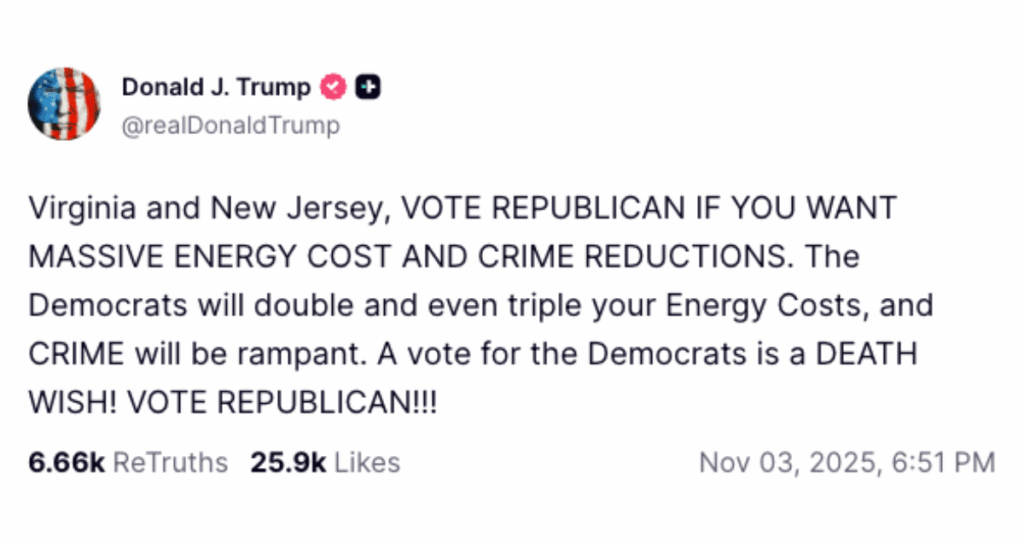
Previewing this midterm strategy, Trump posted on Truth Social the night before the election:

Screenshot of a post on Truth Social from President Trump: Virginia and New Jersey, VOTE REPUBLICAN IF YOU WANT MASSIVE ENERGY COST AND CRIME REDUCTIONS. The Democrats will double and even triple your Energy Costs, and CRIME will be rampant. A vote for the Democrats is a DEATH WISH! VOTE REPUBLICAN!!!

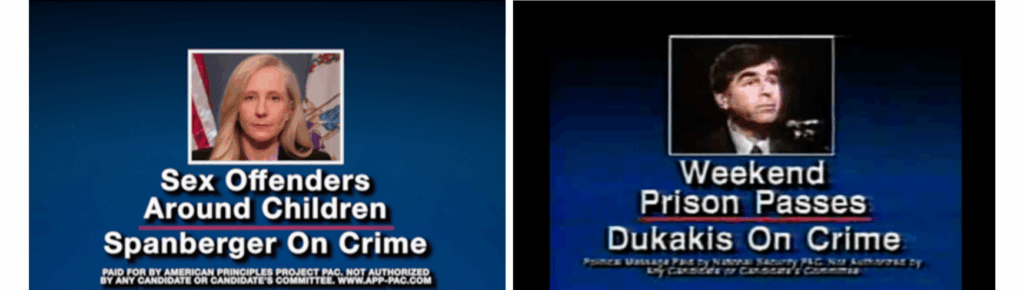
To the extent that crime attacks played a role in this cycle, they were conflated with anti-trans fearmongering. For example, the American Principles Project PAC spent $1 million on an ad mimicking the infamous 1988 Willie Horton ad against Democratic presidential nominee Michael Dukakis, attacking Spanberger for being “soft on crime” and linking it to her alleged support for a trans bathroom policy.

Side-by-side stills of the "Spanberger on Crime" and "Dukakis on Crime" ads.

Just as the GOP did in 2022 and 2024 after losing in 2020, they are likely to once again up the ante on crime and raise its salience in the 2026 midterms by spending millions on crime attack ads and painting Democrats as “soft” and “weak” on the issue.

As they have been in previous cycles, these attacks will be potent if crime is a high priority to voters and candidates leave the attacks unchecked or met with a weak response. And while Spanberger and Sherrill played up their “national security mom” credentials to appear “tough” when crime came up, Vera Action’s polling in both Virginia and New Jersey indicates there is a better way to respond. Our polls found that voters in both states—particularly voters of color and young voters, both of whom turned out at high rates for Spanberger and Sherrill last week—strongly favored by almost a double-digit margin the “serious about safety” approach that mayoral candidates adopted in this year’s races.

More on that approach below.

TAKEAWAY # 2.

In 2025, the new paradigm on safety includes new solutions to prevent crime, respond to crisis, and stop violence—not “tough-on-crime” measures of the past.

In the months leading up to Election Day, debates raged within the Democratic Party about how to address crime. Vera Action’s presentation at the DNC’s summer general meeting about how Democrats can win with a “serious about safety” approach drew harsh criticism and backlash from some moderate political operatives who urge Democrats to lean into “tough-on-crime” rhetoric on policing and the border.

A recent report by WelcomePAC, a group launched to back centrist candidates, calls on Democrats to “affirmatively moderate our positions” on crime, citing the unpopularity of police and prison abolition—positions that virtually no candidates have taken in recent election cycles. While WelcomePAC correctly calls out a major problem in the Democrats’ brand issue and trust deficit on crime, their prescription of embracing a more GOP-like platform misses what a majority of American voters want when it comes to public safety.

There is a majority view among American voters about what works to prevent crime and break its cycle. This “serious about safety” approach consistently beats a “tough-on-crime” one by 20 percentage points.

Importantly, this approach does not dismiss personal responsibility or consequences when someone breaks the law. Voters care about accountability, and they see remorse, repair, and change as more effective than strict punishment.

While pundits and politicians often reduce the political debate about crime to more police funding versus abolishing the police, polling consistently shows that voters support the police and want to hear ideas about better, more accountable policing—not simply more funding or more police.

These results are echoed in an October Gallup poll, released days before the election, which found 67 percent of Americans favor addressing social problems to reduce crime compared to only 29 percent who say strengthening/increasing law enforcement.

The debate about being progressive versus moderate on crime reflects stale thinking on an age-old problem that urgently demands fresh and effective solutions. Safety should transcend partisan gridlock and ideological differences. A new paradigm, based on a “serious about safety” approach, reflects the American majority.

TAKEAWAY # 3.

Mayoral races are the right place to look in the 2025 cycle for lessons on handling crime. From focusing police on serious crime to investing in community violence intervention and mental health response, candidates who owned a new approach to safety won handily.

While the degree to which they adopted a “serious about safety” approach differed greatly, at least 19 mayoral candidates ran and won on a platform featuring a new approach to policing and community-based solutions to prevent crime, respond to crisis, and stop violence.

They include State Senator Sean Ryan, who won election last week after defeating Acting Mayor Chris Scanlon in Buffalo, New York’s closely watched Democratic primary earlier this year. Ryan pledged to “focus on community violence intervention and outreach, and work to offer more support services, education, and job opportunities for young people.”

In San Antonio, the seventh biggest city in the country, Gina Ortiz Jones won   election earlier this year. The former Air Force undersecretary outlined a vision for safety that includes supporting vulnerable groups like seniors, people with disabilities, and immigrants. During the election, she said that she wants to “ensure that our police officers are focused on the violent crimes that are actually threatening our community” rather than taking part in immigration raids.

In Seattle, Katie Wilson defeated incumbent Mayor Bruce Harrell. Crime played a pivotal role in Seattle’s last election cycle, turning into a debate on “law-and-order” politics versus police abolition. This time, Wilson’s “serious about safety” approach has changed the conversation. Wilson drove home a message about building a “responsive, trustworthy, and accountable” police department and speeding up 911 response times. She said police response times are too long because we expect them to do too many jobs and vowed to improve violence prevention and “expand alternative crisis response and other civilian roles, so police can focus on policing.” After losing to Wilson in the August nonpartisan primary, Harrell announced a plan to expand crisis response, indicating the popularity of such measures.

In Detroit, the top two mayoral candidates—City Council President Mary Sheffield and Reverend Solomon Kinloch—adopted comparable public safety platforms. Each placed a strong emphasis on violence prevention, more accountable policing, and more investment in schools, jobs, and opportunities for young people to prevent crime and break its cycle. With crime in Detroit reaching historic lows and two candidates running on this affirmative message, crime was no longer the wedge issue it was in the city’s last election cycle.

Still from a Mary Sheffield for Mayor public safety ad.

Sheffield, who was backed by outgoing mayor Mike Duggan and won with more than three-quarters of the vote, vowed to “build a public safety system that prioritizes prevention” and “ensures justice for all.” She has also committed to launching an Office of Gun Violence Prevention within her first 100 days and fighting for additional community violence intervention funding. Sheffield ran a compelling public safety campaign, turning out ads that addressed her commitment to “safe, vibrant neighborhoods, quality affordable housing, schools with wraparound services, and jobs that pay a higher wage,” and saying that by “creating good jobs, good schools and stronger neighborhoods, we’ll prevent crime.”

In addition to these blue state mayors, multiple candidates in red and purple states—including Louisiana, Ohio, and North Carolina—were elected on a “serious about safety” platform. Justin Bibb, mayor of Cleveland and the chair of the Democratic Mayors Association, won reelection easily on his strong track record on public safety. Last month, in New Orleans, former journalist and the city council president Helena Moreno won the mayoral race outright and avoided a runoff. Moreno published a “Comprehensive Public Safety Plan” focused on “crime prevention, effective policing, and community collaboration,” including investments in good jobs, education, recreation centers, youth programs, housing, and mental health. When New Orleans came under federal and state threats for intervention, Moreno delivered a clear message that turned the tables by calling out the federal government for cutting investments in workforce training, mental health, and substance use treatment—things proven to prevent crime and break its cycle.

Still of Cleveland Mayor Justin Bibb saying "We need a serious-on-safety conversation about addressing the root causes of violent crime" during an interview with The New Republic.

Source: The New Republic.

Even moderate candidates, like Atlanta Mayor Andre Dickens, who has drawn fire on safety policies like the controversial Public Safety Training Center, won reelection on a platform that this time included “a comprehensive strategy that addresses the root causes of crime,” with calls for investments in diversion, violence intervention, and alternative crisis response. Another moderate, Cincinnati Mayor Aftab Pureval, won reelection in a landslide against Vice President JD Vance’s half-brother, Cory Bowman. Pureval touted his investments in the city’s Alternate Response to Crisis Response Team, which dispatches unarmed mental health professionals to intervene in low-risk crises, along with his support for crime prevention through the city’s Place-Based Violent Interruption Strategy (PIVOT) programs.

TAKEAWAY # 4.

Zohran Mamdani demonstrated how to successfully inoculate against millions of dollars invested in “soft-on-crime” attacks and change the terms of the crime debate by proposing a Department of Community Safety—a new solution to an old problem.

In New York City, election eve polling found that crime remains a serious concern for likely voters. This is the city, after all, where Eric Adams won by running a heavily “tough-on-crime” campaign.

This year, many of the candidates in the crowded Democratic primary called for more police to emphasize their “tough-on-crime” bona fides—but not winner Zohran Mamdani. While he did not call for more police funding or officers, he did pivot from his past support for “defund the police” and aligned his position with where a majority of voters are: better, more accountable policing—not simply more police.

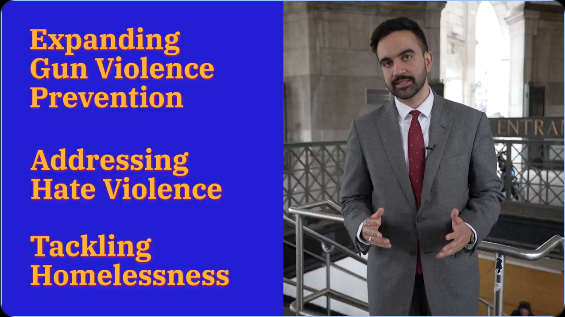
Unlike former Governor Andrew Cuomo, whose signature public safety platform was hiring 5,000 more officers, Mamdani ran on his plans for a new Department of Community Safety to expand mental health services, crisis response, and “prevent violence and crime before they occur.” He emphasized that it would support police by “reliev[ing] the excessive burden we’ve placed on police officers,” thus improving 911 response times and case clearance rates.

Still of a Zohran Mamdani video, addressing his plan to expand gun violence prevention, address hate violence, and tackle homelessness.

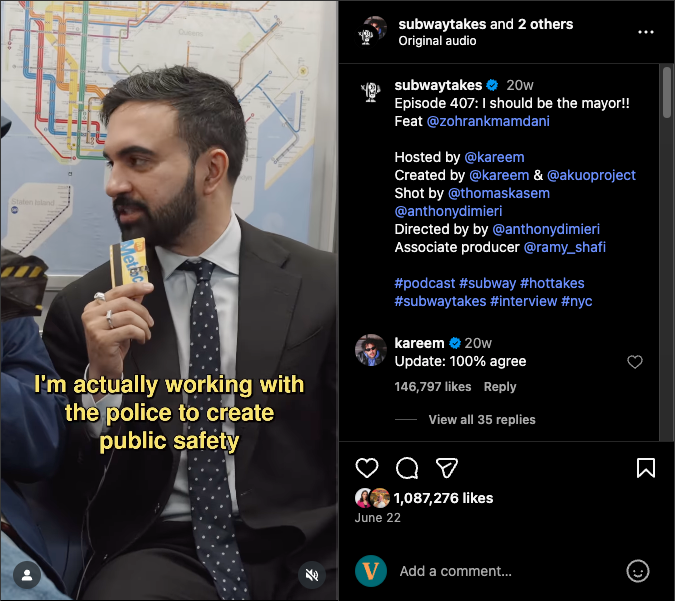
Heading into the primary, Cuomo bet on spending tens of millions of dollars on negative ads painting the assemblyman as a “defund” candidate who didn’t care about crime. But it didn’t work. Mamdani spoke early and often about his current positions on policing, framing them as part, but not the only part, of effective public safety. He distinguished himself from his competition by calling out the tiredness of the “defund” attacks and old ideas about policing, saying that New Yorkers deserve to “go beyond the same ideas that we hear time and time again” which have failed to deliver real safety. Attacks over old tweets didn’t land with the same effect they would have if he remained silent on the issue because he got out ahead of them, letting voters know where he stood.

Screenshot from Instagram of Zohran Mamdani on "Subway Takes."

A New York Times/Siena Poll of general election voters from early September found that Mamdani had a slight edge on handling crime over Cuomo, despite the well-funded barrage of crime attacks against him, including a widely-derided AI-generated ad showing “criminals for Zohran Mamdani.” Throughout the final weeks of the race, Mamdani emphasized safety in his TV ads and in interviews, noting that “public safety is the prerequisite for an affordability agenda…People have to be safe.”

Data table from an NYT/Siena poll showing that in the New York mayoral general election, Zohran Mamdani had the highest level of trust among voters to handle crime, among other issues.

Source: NYT/Siena Poll.

In his victory speech, Mamdani declared that “safety and justice will go hand in hand” during his term as mayor. While he still lost to Cuomo among voters who said crime was their top voting issue, the big lesson here is that “defund” attacks can be neutralized effectively—even when, according to The City, groups supporting Cuomo spent more than $12 million in the final two weeks of the campaign blasting Mamdani on policing.

TAKEAWAY # 5.

Boston Mayor Michelle Wu defied conventional political wisdom by winning the police union endorsement, despite being a progressive and calling for greater police accountability.

In Boston, left-leaning incumbent Mayor Michelle Wu defeated a well-funded primary challenger, Josh Kraft, who put $5.5 million of his own money into his campaign and regularly attacked her handling of crime.

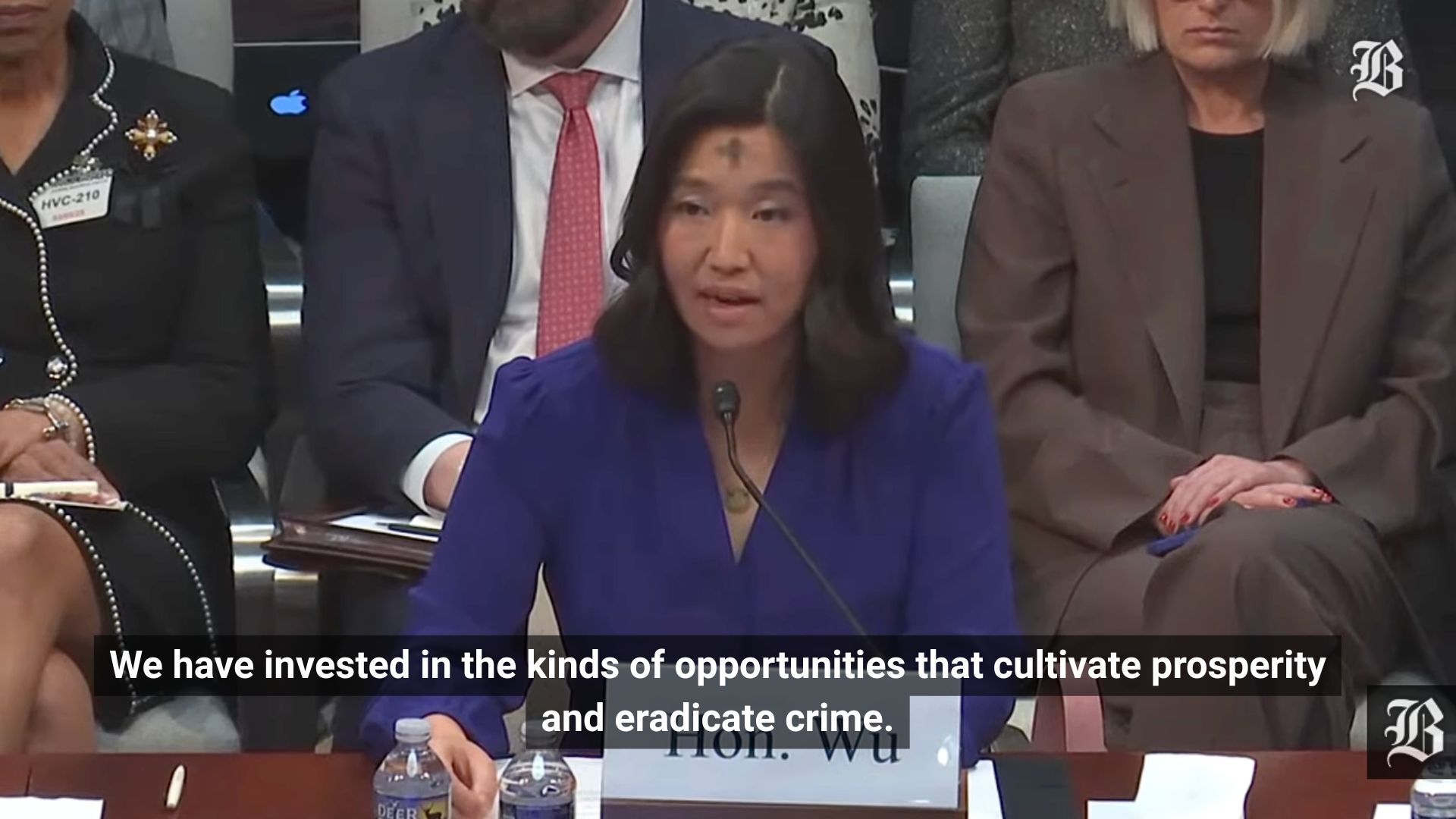
In her March statement to the House Committee on Oversight, Wu outlined the strategy behind Boston’s record crime decline: “Our vision for Boston is not just one where we reduce violence and criminal activity—it is a city where every resident is safe; where every family has access to resources and opportunities in the affirmative. It is not a coincidence that our record low crime rates overlap with record investments in the programs and policies that cultivate prosperity for the residents of our city.” She touted her investments in housing, education, summer youth employment, and more—connecting all of them to safety—and argued that heightened immigration enforcement is making her city less safe.

Still of Boston Mayor Michelle Wu saying, "We have invested in the kinds of opportunities that cultivate prosperity and eradicate crime," during a Congressional hearing.

Source: Boston Globe.

In a surprising twist, the Boston Police Patrolmen’s Association endorsed Wu early in the mayoral race, despite her having been a strong critic of the police during her time as a city councilmember. In 2023, Wu reached a new collective bargaining agreement with the police union. In exchange for an increase in pay, she negotiated police accountability measures including ending arbitration as a way to avoid disciplinary action for the most serious offenses. Wu’s popularity likely also helped the union decide to support her, suggesting that winning public trust can also neutralize opposition

CONCLUSION

American voters want and deserve new solutions to the age-old problem of crime. And yet all signals point to another round of “tough-on-crime” fearmongering, with rumors of a Trump-led crime bill that will likely include many law-and-order proposals of a bygone era. A national bill that Trump can use to signal “toughness” is, cynically, the perfect groundwork for yet another GOP “Willie Horton” play in 2026—a move that played to strong effect in the 2024 cycle, with Trump and the Republicans spending $1 billion to attack Democrats as “weak” and “woke” on crime and immigration. The real question is not if, but how much the GOP will spend on this same strategy in 2026.

A look at this year’s mayoral races, in which both progressive and moderate Democrats ran and won on a “serious about safety” approach, reveals a new path forward for the party to not only inoculate against the GOP’s crime attacks, but also go on offense and turn the debate to safety, accountability, and justice.

Note: This piece was updated on 11/17 to reflect the final election results in Seattle.